

London Luton Airport scored 100/100 in the GRESB sustainability ranking for a fifth year. Its carbon cut of over 40% covers airport operations, not flights.
London Luton Airport has been named a GRESB sector leader for the fifth year running. It scored 100 out of 100 and kept its five-star rating, the airport announced on 15 October.
The airport says it ranked first overall among more than 500 companies worldwide. It was also the highest-ranked airport in its European peer group.
What GRESB is
GRESB is an international benchmark that scores organisations on how they manage environmental, social and governance (ESG) issues. Its results are used mainly by investors in property and infrastructure.
A sector leader is the top scorer in a category, judged by sector, region and type of ownership. GRESB also names anyone within one point of that top score.
GRESB had not published its own 2026 list of sector leaders when we checked on 16 October. The result above is as the airport reported it.
What the airport says has changed
The airport listed these environmental figures in its announcement:
- carbon emissions from airport operations cut by more than 40% compared with 2019
- nearly two thirds of the aircraft based at Luton are now quieter, more fuel-efficient “next generation” models
- emissions from aircraft landing and taking off cut by 13.2% compared with 2019
- 34% of passengers travelled to and from the airport by more sustainable transport, up from 29% in 2024
The 40% figure needs reading carefully. The airport’s own footnote says it covers Scope 1 and Scope 2 emissions. Those are the fuel and energy the airport operator burns or buys itself. It does not include emissions from the flights.
The landing and take-off figure is the only one that covers aircraft. It counts the emissions near the ground, not the rest of each journey.
The local figures
The airport also gave figures for its effect on Luton. It says it:
- delivered more than £44m in social value through local jobs and purchasing, an estimate made with the Social Value Portal’s formulae
- supports about 14,700 jobs locally
- employs half of its own workforce from Luton postcode areas
For 2025 alone, the airport says it:
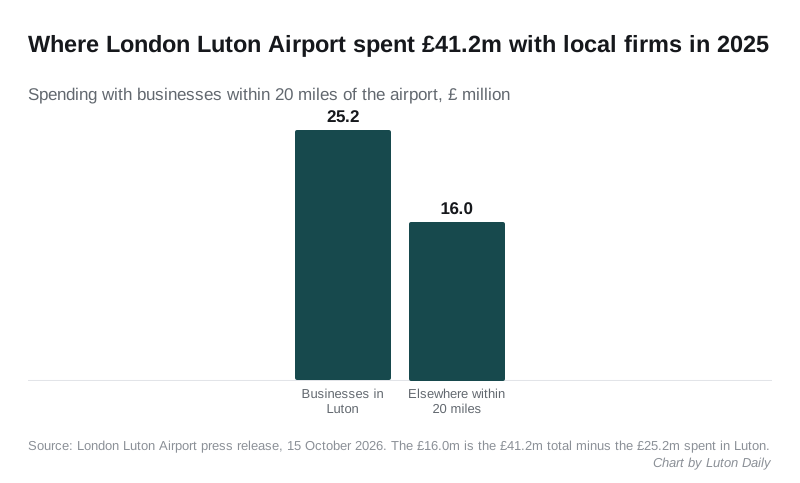
- spent £41.2m with businesses within 20 miles, including £25.2m with Luton businesses
- supported 932 people through its education and skills programmes, taking the total to 1,279
- raised more than £60,000 for its charity partners
- supported 45 community projects, which it says reached more than 34,000 people
- logged 826 hours of staff volunteering, up more than 44% on the year before
The £41.2m spending figure first appeared in the airport’s July announcement. Take away the £25.2m spent in Luton and £16.0m went to firms elsewhere within 20 miles.
Who said what
Alberto Martin, chief executive of London Luton Airport, said keeping a 100% score, a five-star rating and sector leader status for a fifth year “highlights our commitment to demonstrating the highest, most robust ESG management, governance and performance”.
Aena, the airport’s majority shareholder, said in the same announcement that the result reflected “its ongoing commitment to delivering positive environmental and social outcomes”.
What it means for you
The airport belongs to the town. It is owned by Luton Rising, a company wholly owned by Luton Council, and run by a consortium whose majority shareholder is Aena, with InfraBridge. The airport says Luton Rising has put more than £500m into front-line, voluntary and charitable services since 1998.
The ranking measures how well the airport manages and reports on these issues. It does not measure noise over your street or the number of flights. If noise is your concern, the airport is holding public talks on noise and its insulation scheme from 19 to 22 October.
The airport’s 14,580-panel solar farm, now being built inside the airfield, is part of the same push to cut the operator’s own emissions.
Have your say