
Luton Council found £4.19m in developer cash that was due but never paid, £3.18m of it now in. One site accounts for £4m. The 26 October report, case by case.
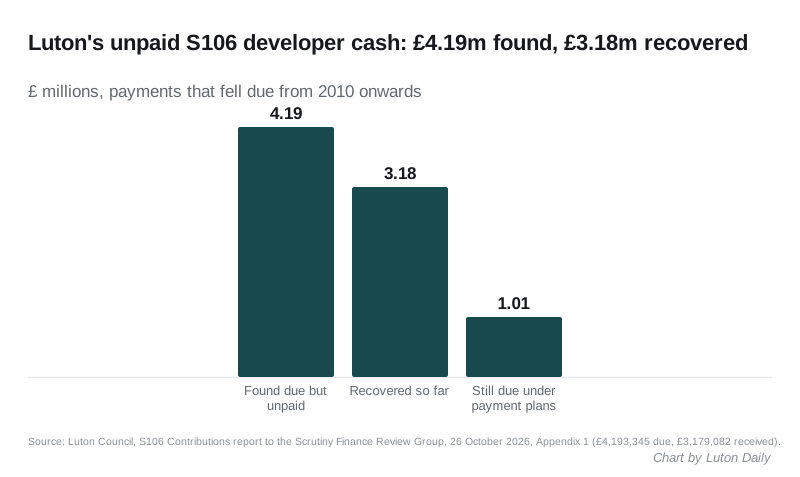
Luton Council has found £4,193,345 in payments from housing and other developers that fell due and were never collected. So far it has recovered £3,179,082 of that money. The rest, about £1.01 million, is being paid in instalments.
The figures are in a report to the council’s Scrutiny Finance Review Group, which met on Monday 26 October. It is the first time the council has published the sums development by development.
What S106 money is
When the council grants planning permission, it can make the developer sign a Section 106 agreement. The developer then pays towards things the new homes or buildings will put pressure on, such as school places, roads or open space. The money is ring-fenced: it can only be spent on what the agreement says.
The payments usually fall due at a trigger point, such as when building starts or a set number of homes are occupied. If nobody checks that the trigger has been reached, nobody sends the bill.
How the money was missed
The report says a review of the council’s arrangements found “opportunities to strengthen the monitoring and financial oversight” of these agreements. Councillors were consulted on changes in December 2025.
Officers then went back through every agreement since records began in 1990:
- 494 S106 agreements have been signed since 1990
- 103 needed further investigation to work out whether money was owed
- agreements from 1990 to 2010 were found to be either paid or never triggered
- unpaid sums were found for payments that fell due from 2010 onwards
The report says the work is not finished. Further developments are still being checked, so the figures “should therefore be regarded as the current position rather than the conclusion of the historic review”.
The developments that had not paid
The report’s appendix lists eight agreements. The original sum is what the agreement set out; the amount due is what the council says it was owed by the time it chased the money.
| Development | Agreement signed | Original sum | Amount due | Paid so far |
|---|---|---|---|---|
| 19 Albert Gardens | Nov 2010 | £1,022 | £1,860 | £1,860 |
| 37 to 39 Ramridge Road | Sep 2013 | £34,056 | £59,200 | £59,200 |
| 8 Rockley Road | Jan 2014 | £11,352 | £17,765 | £17,765 |
| 116 to 124 Wingate Road | May 2017 | £10,700 | £22,186 | £22,186 |
| 4 George Street | Feb 2021 | £40,455 | £48,534 | £48,534 |
| 286 Hitchin Road | Nov 2010 | £4,002 | £7,259 | £4,902 |
| 118 New Bedford Road | Mar 2011 | £12,582 | £22,016 | £13,760 |
| Caddington Road and Newlands Road | Jul 2020 | £2,815,397 | £4,014,525 | £3,010,875 |
| Total | £2,929,566 | £4,193,345 | £3,179,082 |
The first five have paid in full. The last three are on payment plans.
One agreement dwarfs the rest. The development at Caddington Road and Newlands Road accounts for £4,014,525 of the £4.19 million, about 96 per cent. About £1.0 million of it is still to come.
The two oldest cases, at Hitchin Road and New Bedford Road, date from agreements signed in 2010 and 2011.
How big that is
The report compares the recovered money with the council’s ordinary S106 income. Since 2010, the normal process collected about £15 million. The missed payments found by the review add up to more than a quarter of that again.
By period of when the money fell due:
- 2010 to 2015: £108,100 due, £97,487 recovered
- 2016 to 2021: £4,085,245 due, £3,081,595 recovered
- 2021 to 2026: nothing found unpaid so far
The report rounds its totals differently in two places. One paragraph says £3.1 million recovered with £1.1 million to come; its conclusion says £3.2 million and £1.0 million. The table, which we have used here, gives £3,179,082 recovered and £1,014,263 outstanding.
What the money has already paid for
The report gives one example. The money recovered from the 8 Rockley Road development has paid for:
- fencing
- a feasibility study for inclusion bases
- an access gate
all at three Luton primary schools, which the report does not name.
What changes now
The council is moving its S106 records onto a single system called Exacom. A small team of temporary officers, including one care leaver, has been doing the recovery work. The council intends to make those posts permanent and pay for them from the monitoring fees charged through S106 agreements.
The next phase, according to the report, will:
- finish the review of historic records
- pursue any further unpaid sums it finds
- make Exacom the central record for every agreement
- set clearer responsibility for who monitors each contribution
- tie planning, finance and the services that spend the money more closely together
- watch spending deadlines, so money is not handed back to developers unspent
The group was asked only to note the report. The minutes of the meeting, including what councillors said and decided, have not yet been published. We will update this story when they are.
What it means for you
S106 money is how a new development pays its share of the local school places, roads and green space it needs. When it goes uncollected, those costs either fall on the council’s general budget or the improvements do not happen.
If you live near one of the developments listed above, the money it owed is tied to that scheme’s agreement and has to be spent on what the agreement names. Each agreement sits on the council’s planning register under its application number: 10/01202/FUL for Albert Gardens, 13/00882/FUL for Ramridge Road, 13/01562/FUL for Rockley Road, 10/00978/FUL for Hitchin Road and 10/01255/FUL for New Bedford Road. Our Luton planning news page explains how to search it.
Have your say