
London Luton Airport has replaced diesel ground equipment with a shared electric fleet of 175 machines. Its solar farm is due to start generating in March 2027.
London Luton Airport has switched its baggage tractors, pushback vehicles and passenger steps from diesel to electric. The new fleet of 175 machines is shared by every airline ground handler at the airport.
Aviation minister Keir Mather MP started the system on Friday 20 November. The airport announced the switch the same day.
What is in the fleet
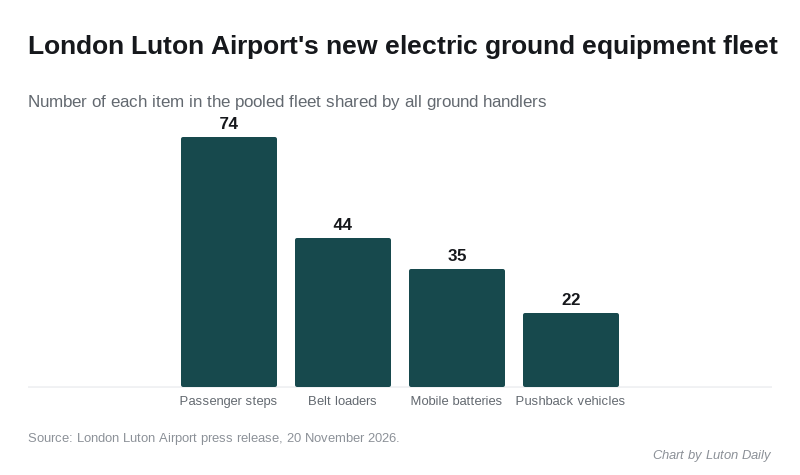
The airport’s notes to its release list the full electric provision:
- 74 sets of passenger boarding steps
- 44 belt loaders, which carry bags into and out of the hold
- 35 mobile batteries
- 22 pushback vehicles, which tow aircraft back from the stand
That makes 175 items in all. The equipment was sourced with TCR, a company that supplies electric ground equipment to airports.
Why there are no new charging points on the stands
Luton is not digging up its stands to lay cables. The machines are charged from the 35 mobile batteries instead, which move around the apron.
The airport said this avoids “disruptive groundworks and oversized power infrastructure”. It tried the idea on five aircraft stands in 2025 before rolling it out.
The fleet is pooled, so airlines’ handling companies share the same equipment rather than each bringing their own. The airport said pooling has run at Luton for nearly a decade. Fewer machines are needed on each stand as a result.
What the airport and the minister said
The airport expects quieter ground operations for passengers and staff, faster turnarounds between flights, and lower running costs and carbon emissions.
Mr Mather said: “Going electric on the ground, backed by a new solar farm, is a real step towards net zero, and it benefits passengers, staff and the local area.”
Alberto Martin, the airport’s chief executive, called it “a significant stride forward in the decarbonisation of our ground operations”.
The airport has not said how much the switch cost, or how much carbon the electric fleet will save each year.
The solar farm: generating from March 2027
The minister also toured the solar farm being built south of the runway. The airport’s release gives these figures for it:
- a 26-acre site with more than 14,000 panels
- up to 11.2 gigawatt hours of electricity a year
- more than a third of the airport’s current electricity demand
- a predicted saving of 1,982 tonnes of carbon dioxide equivalent in its first year
It is due to start generating in March 2027. When work began in September, the firms building it had given only “early 2027”.
The airport is run by a consortium whose majority shareholder is the airport operator AENA. It is owned by Luton Rising, a company wholly owned by Luton Council.
What it means for you
If you fly from Luton, the vehicles loading your bags and towing your aircraft back should now be electric and quieter on the stand.
For people living near the airport, the gain is less clear. The release talks about lower ground noise for passengers and staff, but gives no figures for noise heard beyond the airfield. Aircraft noise, which is what most neighbours notice, is not affected by this change.
Have your say