

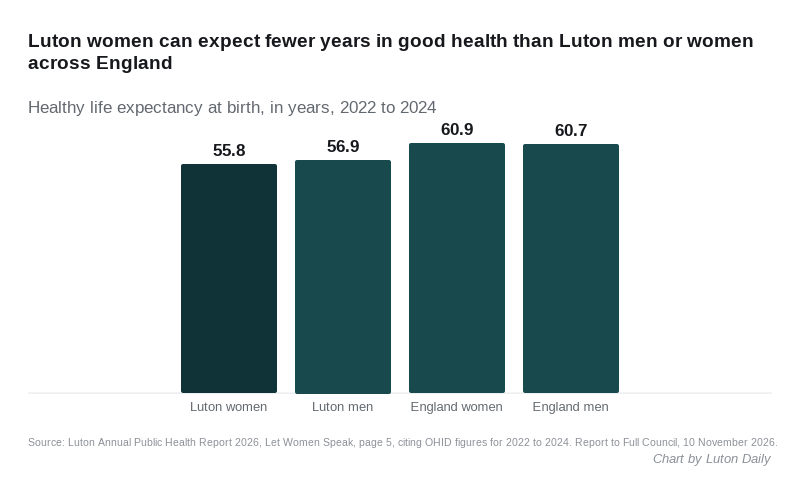
Women in Luton can expect 55.8 years in good health, five fewer than women across England. The council's public health report sets out 19 changes.
Women in Luton can expect to live 83 years, but only 55.8 of them in good health. That leaves around 27 years lived with illness, disability or poor wellbeing.
The figures are in the borough’s Annual Public Health Report 2026, titled “Let Women Speak”. Every director of public health must publish an independent report each year. Luton’s director, Kelly O’Neill, and her team wrote this one, and it went to Full Council on Tuesday 10 November. It is item 10 in that meeting’s papers.
Luton men can expect 77.7 years of life and 56.9 years in good health. So Luton women live longer than men but have fewer healthy years. The report says that is the opposite of the national pattern, where women’s healthy life expectancy is higher than men’s.
Across England, the report gives women’s healthy life expectancy as 60.9 years, so Luton women fall about five years short. The figures are for 2022 to 2024, from the Office for Health Improvement and Disparities.
What women told the council
The report is built around what women in Luton said about their own health. Public health staff and volunteers from Luton All Women’s Centre spoke to more than 250 women. They went to community settings, faith venues and local groups over the winter.
The report says most women told them they did not put their own health first, especially when they were caring for children, partners or older relatives. They named these barriers:
- stress and caring responsibilities
- money worries and poverty
- poor mental health
- domestic abuse
- loneliness and isolation
- too few safe, affordable places to be active
- difficulty getting appointments for preventative care
To make the findings readable, the report follows a fictional woman, Aaliyah, from the age of 14 to 77. Her story is drawn from what the women said.
The numbers behind it
The report sets the stories beside local and national data. These are the gaps it records between Luton and England.
| Measure | Luton | England |
|---|---|---|
| Cervical screening take-up, women aged 25 to 49 | 52.5% | 66.1% |
| Cervical screening take-up, women aged 50 to 64 | 69.2% | 74.3% |
| Eligible women who had a breast screen in 2025 | 63% | 71% |
| Women who are economically active | 47.3% | 51.5% |
| Women with no qualifications | 24.4% | 19% |
| Babies born with a low birthweight | 4.3% | 3.0% |
| Adults who report feeling lonely (men and women) | 8.4% | 6.8% |
Menopause care stands out. In 2023/24 only 6.1% of Luton women aged 40 and over were prescribed hormone replacement therapy. The report says that puts Luton 290th of 295 local authorities. In some wards, fewer than 3% of women over 40 were receiving it.
The figures for girls are stark too. The council’s 2026 school survey, run by the Schools Health Education Unit, found:
- 62% of girls worry “quite a lot” or “a lot” about exams
- 44% of Year 8 girls reported medium to low self-esteem, against 21% of boys
- only 22% of girls were classed as physically active, against 55% of boys
- 22% of girls feel unsafe because of other people’s alcohol or drug use
- 65% of older girls do not know where their nearest sexual health service is
There are 112,400 women and girls in Luton, according to the report, almost exactly half the town.
The 19 recommendations
The report makes 19 recommendations for the council, the NHS and voluntary groups. They are grouped under nine headings. The main ones are:
- report health outcomes by gender as a matter of routine
- shift spending towards prevention and early intervention
- help women into work, with flexible jobs and routes back after maternity leave or caring
- make income and benefits checks part of all health work
- improve mental health support, with extra help around becoming a parent, divorce and bereavement
- create safe, affordable and women-friendly places to be active, including women-only sessions
- better support for unpaid carers, including respite
- keep investing in safe housing and support for women and children leaving domestic abuse
- make women’s safety a priority in the Luton Local Plan, including the town centre and parks
- offer screening and health appointments at times and places that fit around work and caring
- target cervical screening, breast screening, contraception and vaccination at the groups least likely to use them
- involve women in designing and judging the services they use
The report says the council now plans a full women’s health needs assessment and a Women’s Health Strategy for Luton. Women’s health becomes a new public health workstream.
What happens next
Full Council was asked to note the report and support its recommendations. The minutes of the 10 November meeting have not yet been published, so we cannot say how the debate went.
The recommendations do not come with a budget or a timetable in the report. They feed into existing plans, including the health and wellbeing strategy, the domestic abuse strategy and the plan for ageing well.
What it means for you
- If you are aged 25 to 64, check whether your cervical screening is due. Luton’s take-up is well below the national rate. Your GP practice can book it.
- If you are 50 to 71, you should be invited for breast screening every three years. If you missed an invitation, the NHS says you can contact your local breast screening service to rebook.
- If menopause symptoms are affecting you, ask your GP about treatment, including HRT. Luton’s prescribing rate is among the lowest in England.
- The report lists local services that can help. Luton Family Hubs support families. Total Wellbeing Luton runs healthy lifestyle programmes and talking therapies. Luton Sexual Health covers contraception and testing. The Bedfordshire Domestic Abuse Partnership lists support for anyone experiencing abuse.
Have your say